
Stop comparing yourself to others is the advice everyone gives and the hardest to follow, especially when everyone around you seems to be ahead. Here is a way to see why it feels so hard, and how to change it.
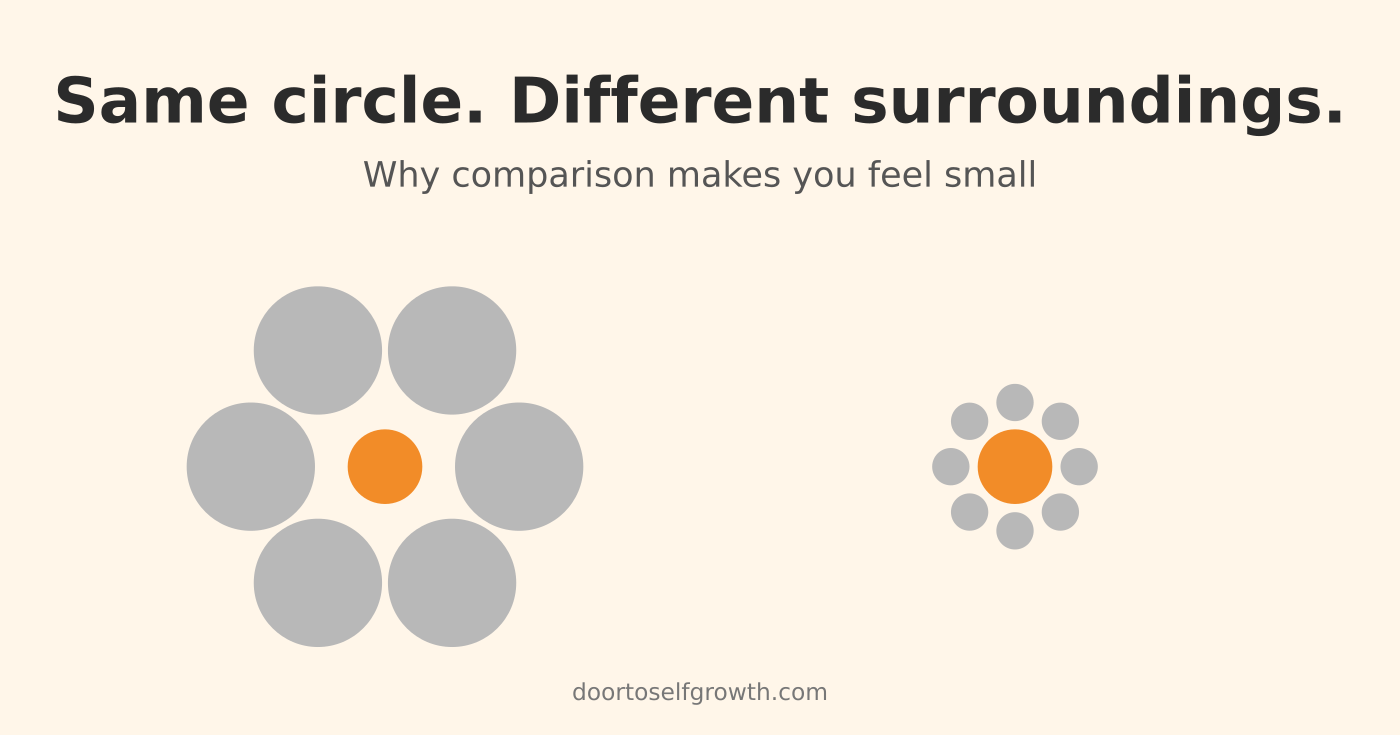
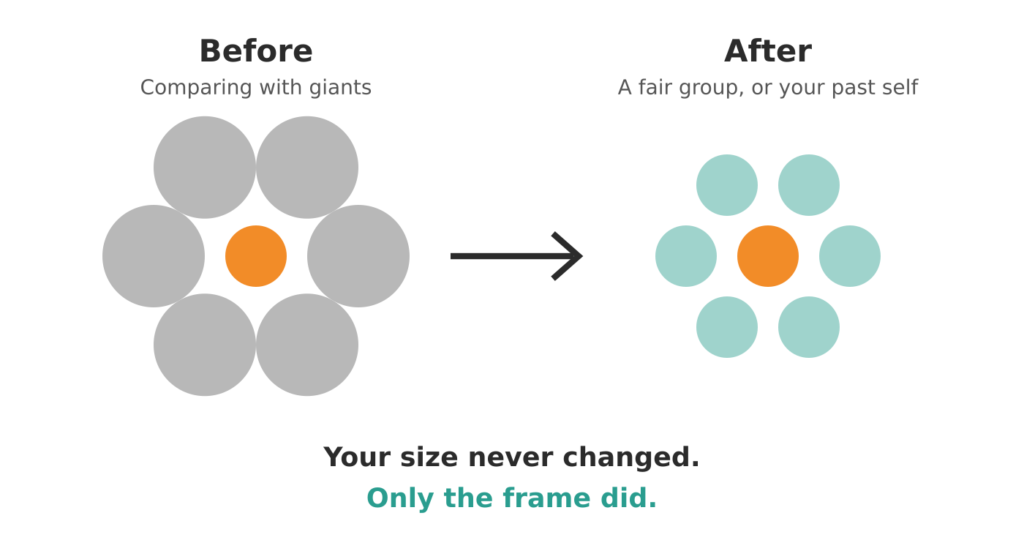
Look at two orange circles. One sits inside a ring of large circles. The other sits inside a ring of tiny ones. Which is bigger?
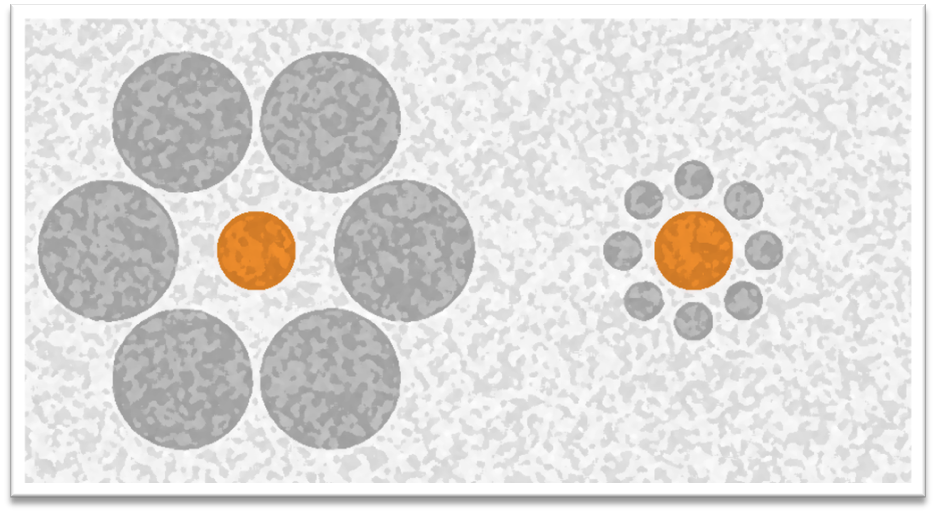
Almost everyone says the one among the small circles. In reality, they are exactly the same size.
You feel smaller around people who seem bigger because the mind judges nearly everything by its surroundings, not by an absolute measurement. This classic trick of the eye, the Ebbinghaus illusion, is a simple picture of how comparison quietly distorts the way we see our own worth. In this article you will learn what the illusion is, what psychology research says about comparison and self-esteem, and six practical ways to change the “circles” around you.
Key takeaways
- The Ebbinghaus illusion shows that context changes how big something looks, even when it has not changed at all.
- Psychologists have studied this kind of comparison in people since Leon Festinger’s 1954 theory of social comparison.
- Experiments suggest that looking at people who seem better off on social media tends to lower self-evaluations and mood.
- You cannot always change your surroundings, but you can change what you compare, how often, and how kindly you talk to yourself.
What is the Ebbinghaus illusion?
The Ebbinghaus illusion, also known as Titchener circles, is an optical illusion of relative size. It is named after the German psychologist Hermann Ebbinghaus (1850–1909), best known for his work on memory. It became popular in English-language psychology after Edward Titchener included it in a 1901 textbook, which is why it carries his name too.
In the best-known version, two identical circles are placed side by side. One is surrounded by large circles and the other by small ones. The central circle among large circles looks smaller, and the one among small circles looks larger.
Even once you know the truth, the illusion does not fully disappear. You can measure the circles with a ruler and still feel they are different.
Also Read: Self-Love Is Choosing Peace
Why does your brain fall for it?
Your visual system does not work like a ruler. It compares each object with what surrounds it. Researchers have found that the distance between the central circle and the surrounding circles also matters: closer neighbours tend to make the centre look larger, and distant ones make it look smaller.
Scientists are still debating the exact mechanism, and the question of how the illusion arises is described as unresolved in the research literature. What is well established is the practical lesson: perception depends on context. The same circle can look big or small depending on its neighbours.
What does a circle illusion have to do with self-worth?
The illusion is not proof of how self-esteem works, so treat it as a metaphor. But it is a powerful one, because psychology has a long record of showing that people judge themselves in relation to others.
In 1954, social psychologist Leon Festinger published “A Theory of Social Comparison Processes” in the journal Human Relations. His central idea was that people have a drive to evaluate their abilities and opinions, and when there is no clear objective standard, they use other people as the yardstick. Later researchers added the now-familiar terms:
- Upward comparison: measuring yourself against someone who seems better off or more skilled.
- Downward comparison: measuring yourself against someone who seems worse off.
Upward comparison can inspire you when the other person’s achievement feels reachable. But it can also bring envy and self-doubt, especially when the gap seems impossible to close. People also tend to compare themselves with others who are similar to them, such as classmates, colleagues, relatives, or friends of the same age.
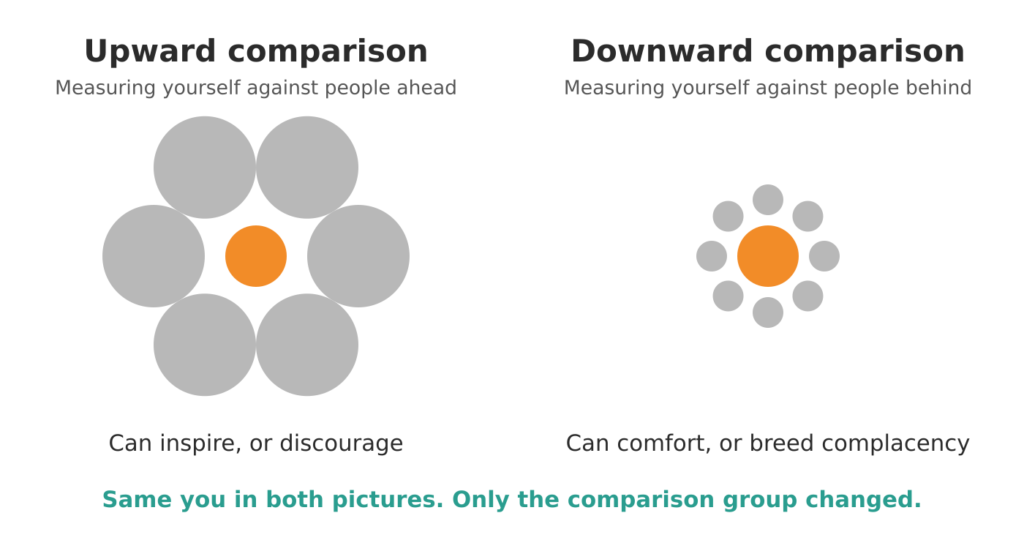
Here is where the circles come in. Imagine you are the orange circle. If everyone in your ring looks larger, you feel small. If you move to a ring of different people, nothing about you changes, but the feeling does. Your size did not shrink. Your frame changed.
Is social media making the illusion stronger?
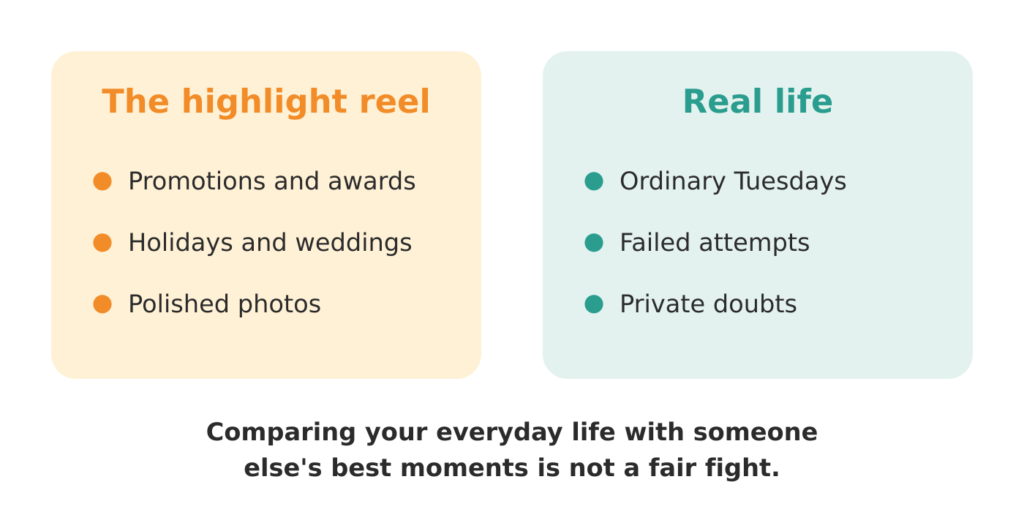
Social media places a very large ring of “bigger circles” in your pocket. Feeds are filled with highlights: promotions, holidays, weddings, fitness results, polished photos. Real life, with its dull Tuesdays and failed attempts, rarely gets posted.
Research backs up the concern:
- A 2023 meta-analysis in Media Psychology by Carly McComb, Eric Vanman, and Stephanie Tobin pooled 48 experimental studies with 7,679 participants. It found an overall negative effect of upward comparison on social media on self-evaluations and emotions (effect size g = −0.24). The effect was largest for body image, followed by self-esteem, mental health, and well-being, and it did not depend on age or gender.
- A 2020 study by Claire Midgley and colleagues in the Journal of Personality and Social Psychology (four studies, 798 participants) found that more frequent and more extreme upward comparisons led to immediate drops in self-evaluation, and to lower state self-esteem, mood, and life satisfaction after browsing. People with lower self-esteem were more likely to make extreme upward comparisons, and comparisons on social media hurt self-evaluation more than comparisons in other settings.
- A 2026 meta-analysis in Frontiers in Psychology covering 54 samples and 36,583 participants found that online upward comparison was moderately associated with poorer psychological functioning (average correlation r = 0.33), with the strongest links to negative social-evaluative emotions and anxiety. Most findings of this kind are correlational, so they show a link, not proof of cause.
These are averages across many people. Your own experience may be better or worse, and social media can also bring support and connection. But the pattern is consistent enough to take seriously.
Also Read: Mindless Scrolling: Break the Cycle & Reclaim Your Focus
Why do the “surroundings” matter so much?
Your circles are not only on a screen. They include the family member who is always compared to a high-achieving sibling, the workplace where everyone seems more confident, the class where you are the one who struggles, and the group chat where everyone else seems to be announcing good news.
Context shapes expectations. If you grew up hearing how far behind you were, you may judge yourself harshly even when you are doing well. If you grew up surrounded by encouragement, you may feel more capable at the same level of skill. The person has not changed, only the circles around them.
The good news is that this is not fixed. Thought patterns and environments can be changed gradually, even if the change takes time.
Six ways to stop comparing yourself to others
1. Notice the frame before you judge the circle
When you think “I am not good enough,” pause and ask: compared with whom? Naming the comparison group often shows that the yardstick is unfair, such as someone with ten more years of experience, a different starting point, or a carefully edited public image.
2. Audit what you look at every day
Research on social media comparison suggests that what you see repeatedly shapes how you feel. Unfollow or mute accounts that leave you feeling worse, and add ones that teach, inform, or genuinely encourage you. Set a time limit for scrolling if browsing leaves you drained.
3. Compare with your own past
Instead of asking “Am I as good as them?”, ask “Am I better than I was six months ago?” This keeps the focus on growth you can control. Keep a short progress note: one skill learned, one fear faced, one habit kept.
4. Treat upward comparison as information, not a verdict
Psychologists note that upward comparison can motivate when the goal feels achievable. If someone’s success makes you uncomfortable, ask what specific step they took that you could try. Turn envy into a question: “What does this show me that I want?”
5. Practise self-compassion
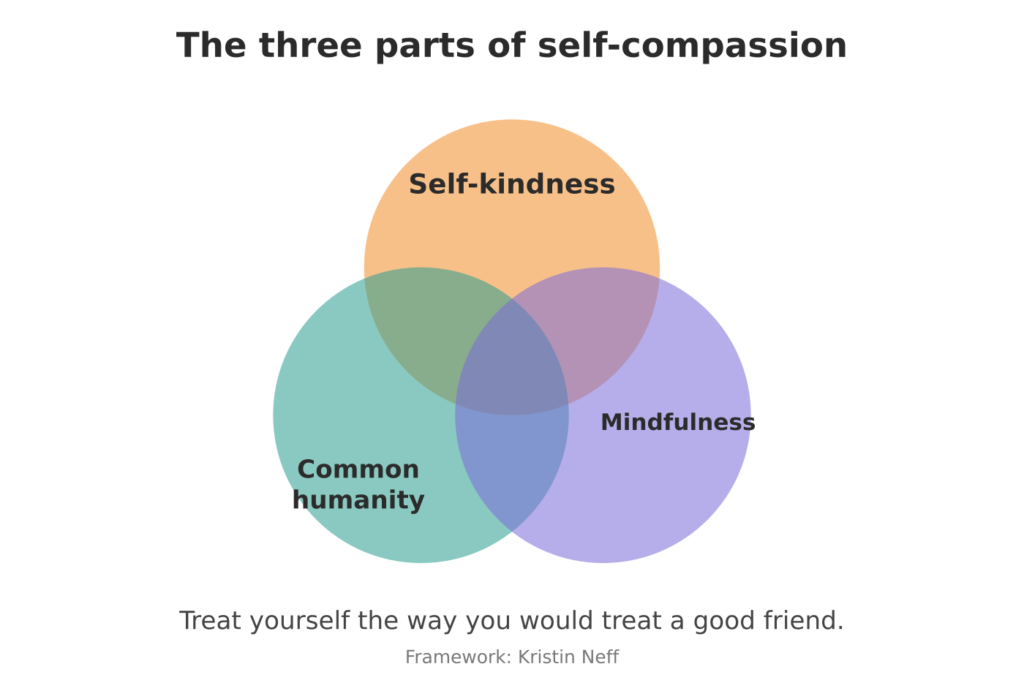
Self-compassion researcher Kristin Neff describes it as treating yourself the way you would treat a good friend who is struggling. Her model includes self-kindness, a sense of common humanity (everyone struggles and falls short), and mindful awareness of painful feelings.
Also Read: Life Awakening: Mindful Living Journey
In a 2009 study, Neff and Roos Vonk found that self-compassion was linked to more stable feelings of self-worth than self-esteem was, and had a stronger negative association with social comparison. In plain terms, people who are kinder to themselves tend to be less caught up in comparing.
Self-compassion is not self-indulgence. Research reviewed by Neff suggests it does not lower motivation, and that people high in self-compassion still care about correcting mistakes.
Also Read: Self-Actualization: Unlocking Your True Self
6. Set small, measurable targets
Big goals can feel like another ring of larger circles. Break them down. If speaking up in meetings is hard, aim for one comment this week. If you are learning a new language, aim for five minutes of speaking a day. Small wins give you evidence of progress that does not depend on anyone else.
Try the two-circle exercise
- Draw one circle on paper and trace it exactly to make a second identical one.
- Surround one with large circles and the other with small circles.
- Show it to a friend or family member and ask which is bigger. Then show them it is the same circle.
- Write down one area where you feel “small” and list who you are comparing yourself with.
- Ask: is this the right group to compare with? What would a fairer ring look like?
The point is not to prove anything about intelligence. It is to experience how easily context can make us misjudge, and to practise pausing before we do it to ourselves.
Frequently asked questions
What is the Ebbinghaus illusion?
It is an optical illusion of relative size. Two identical circles look different when one is surrounded by large circles and the other by small circles. It is also called Titchener circles.
What is social comparison theory?
It is a theory proposed by Leon Festinger in 1954. It says people evaluate their abilities and opinions by comparing themselves with others, especially when there is no objective standard.
Does comparing yourself to others on social media hurt self-esteem?
On average, experimental research suggests it can. A 2023 meta-analysis found a small but significant negative effect of upward comparison on self-evaluations and emotions. Individual experiences vary.
How can I stop comparing myself to others?
You may not stop completely, because comparison is a natural habit. You can reduce its harm by curating your feed, comparing with your own past, treating comparison as information, practising self-compassion, and setting small goals.
Read: Why Don’t I Love Myself? Understanding Self-Love
When should I seek professional help?
If feelings of worthlessness, anxiety, or low mood are persistent or affect daily life, consider speaking with a qualified mental health professional or a doctor. This article is for general education and is not medical advice.
Final thought
The orange circle never changed size. Only its surroundings did. The next time you feel small, check the ring before you judge the circle. To stop comparing yourself to others, choose your surroundings, your comparisons, and your self-talk with a little more care.
Sources
- Festinger, L. (1954). A theory of social comparison processes. Human Relations, 7(2), 117–140.
- McComb, C. A., Vanman, E. J., & Tobin, S. J. (2023). A meta-analysis of the effects of social media exposure to upward comparison targets on self-evaluations and emotions. Media Psychology. Read the study
- Midgley, C., Thai, S., Lockwood, P., Kovacheff, C., & Page-Gould, E. (2020). When every day is a high school reunion: Social media comparisons and self-esteem. Journal of Personality and Social Psychology.
- “Looking up” linked to feeling down: a meta-analysis of online upward social comparison and psychological maladjustment (2026). Frontiers in Psychology. Read the study
- Neff, K. D., & Vonk, R. (2009). Self-compassion versus global self-esteem: Two different ways of relating to oneself. Journal of Personality, 77(1).
- Neff, K. D. (2009). The role of self-compassion in development: A healthier way to relate to oneself. Human Development, 52(4), 211–214. Read the article
- Roberts, B., Harris, M. G., & Yates, T. A. (2005). The roles of inducer size and distance in the Ebbinghaus illusion (Titchener circles). Perception, 34(7), 847–856.
- Noba Project / Introduction to Social Psychology: Social Comparison
- Illusions Index: Ebbinghaus Illusion
Image credits
Ebbinghaus illusion illustration: created for this article.